Unmet Clinical Need
The "Stranded" Shock Patient
Cardiogenic Shock (CS) is a medical emergency with a mortality rate of 50-60%.¹ Patients with CS experience a series of disturbances in blood flow, pressure, and resistance that lead to the need for circulatory support. For heart failure patients who survive the initial CS crash and are salvaged, the key question becomes what comes next.
Today, Impella 5.5 is often used for post-salvage stabilization. While Impella 5.5 may be effective for initial stabilization, its mechanical bearings, purge system, external hardware, and ICU-dependent monitoring keep patients ICU-bound and non-dischargeable.
The current gold standard may work for some CS Acute Myocardial Infarction (AMI) cases, where support needs may resolve within weeks. However, it is a poor fit for many CS-HF patients who want to get out of the hospital and back to life and are facing more long-term support needs. For these patients, Hemoglide has been designed to be the answer.
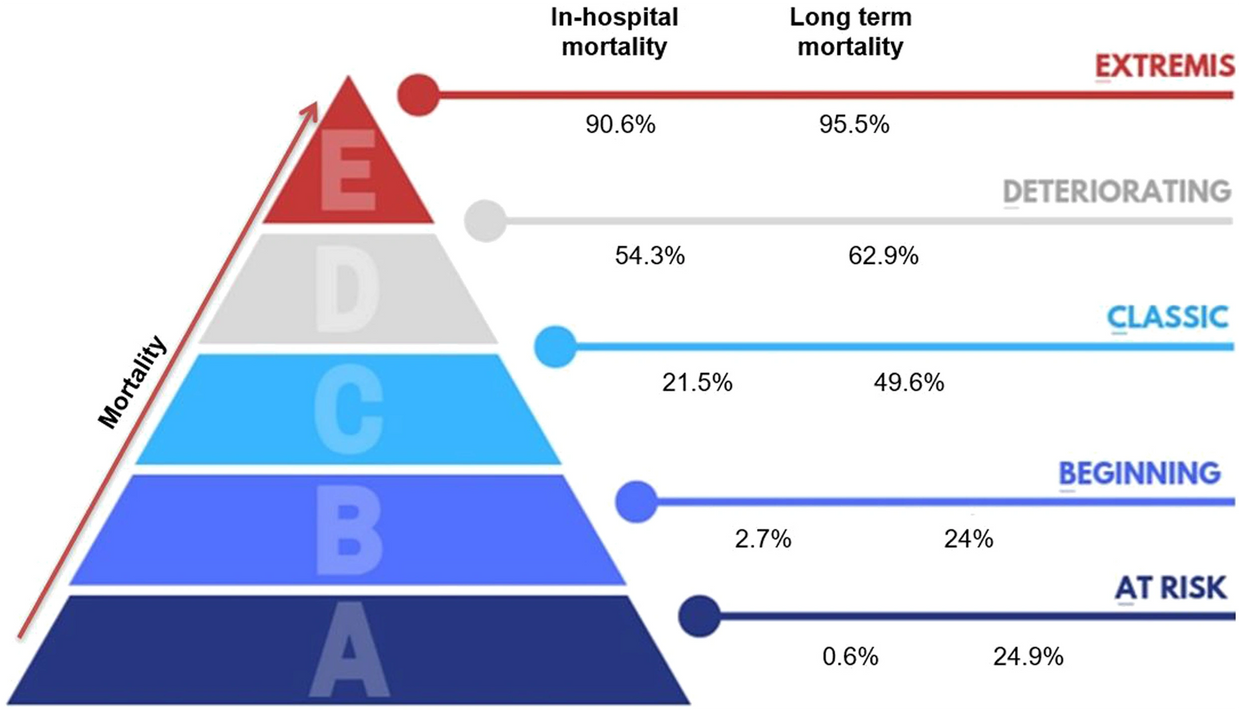
This figure from the Society for Cardiovascular Angioplasty & Intervention (SCAI) shows that in-hospital mortality and long-term mortality rates of CS are both very high.² We expect the Hemoglide VAD to provide both survival and quality of life benefits to patients who are primarily in shock stages C and D.
The 4 S Care Pathway for Cardiogenic Shock (CS)
Salvage
Stabilize
Stabilize
Keeping the patient alive through CS.
Stabilize
Stabilize
Stabilize
Restoring hemodynamics and protecting end-organ function.
Support
Stabilize
Send Home
Enabling continued recovery, ambulation, and safer step-down care.
Send Home
Stabilize
Send Home
Discharge eligible patients out of the hospital as soon as they are ready.
Beachhead Market: patients with CS and heart failure
There are currently 100,000 annual eligible patients in the United States.³
Future Market Expansion Opportunities
C2D Heart Failure Patients
C2D heart failure is a progression from having structural heart disease with current or previous heart failure symptoms (Stage C) into experiencing symptoms that disrupt daily activities and may require hospitalization (Stage D).⁴ The current standard of care for these patients is for them to be ambulatory and homebound on IV inotropes.
Diastolic Heart Failure (Heart Failure with Preserved Ejection Fraction) Patients
These patients are a large later-stage market opportunity with a modified access and cannulation strategy.
Newborns and Infants
This is a smaller market, but will have high impact where size truly matters. This would involve the same pump housing and profile with a modified rotor that would circulate between 0.5 to 1.5 L/min of blood.⁵
Partial Support for Less Sick Heart Failure Patients
This is a longer-term market goal to provide support for these patients. Hemoglide would likely be enabled by a wireless energy and data transfer system.
References
- Aissaoui N, Puymirat E, Simon T, et al. Long-term outcome in early survivors of cardiogenic shock at the acute stage of myocardial infarction: a landmark analysis from the French registry of Acute ST-elevation and non-ST-elevation Myocardial Infarction (FAST-MI) Registry. Crit Care. 2014;18(5):516. Published 2014 Sep 19. doi:10.1186/s13054-014-0516-y
- Baran DA, Grines CL, Bailey S, et al. SCAI clinical expert consensus statement on the classification of cardiogenic shock. Catheterization and Cardiovascular Interventions. 2019;94(1). doi:10.1002/ccd.28329
- Watanabe A, Miyamoto Y, Ueyama HA, et al. Impacts of Hospital Volume and Patient-Hospital Distances on Outcomes of Older Adults Receiving Percutaneous Microaxial Ventricular Assist Devices for Cardiogenic Shock. Circulation: Cardiovascular Interventions. 2024;17(12). doi:10.1161/circinterventions.124.014738
- Dunlay SM, Pinney SP, Lala A, et al. Recognition of the Large Ambulatory C2D Stage of Advanced Heart Failure-A Call to Action. JAMA Cardiol. 2025;10(4):391-398. doi:10.1001/jamacardio.2024.5328
- Olia SE, Wearden PD, Maul TM, et al. Preclinical performance of a pediatric mechanical circulatory support device: The PediaFlow ventricular assist device. J Thorac Cardiovasc Surg. 2018;156(4):1643-1651.e7. doi:10.1016/j.jtcvs.2018.04.062
Copyright © 2026 Miniscule Inc - All Rights Reserved.
Powered by GoDaddy